
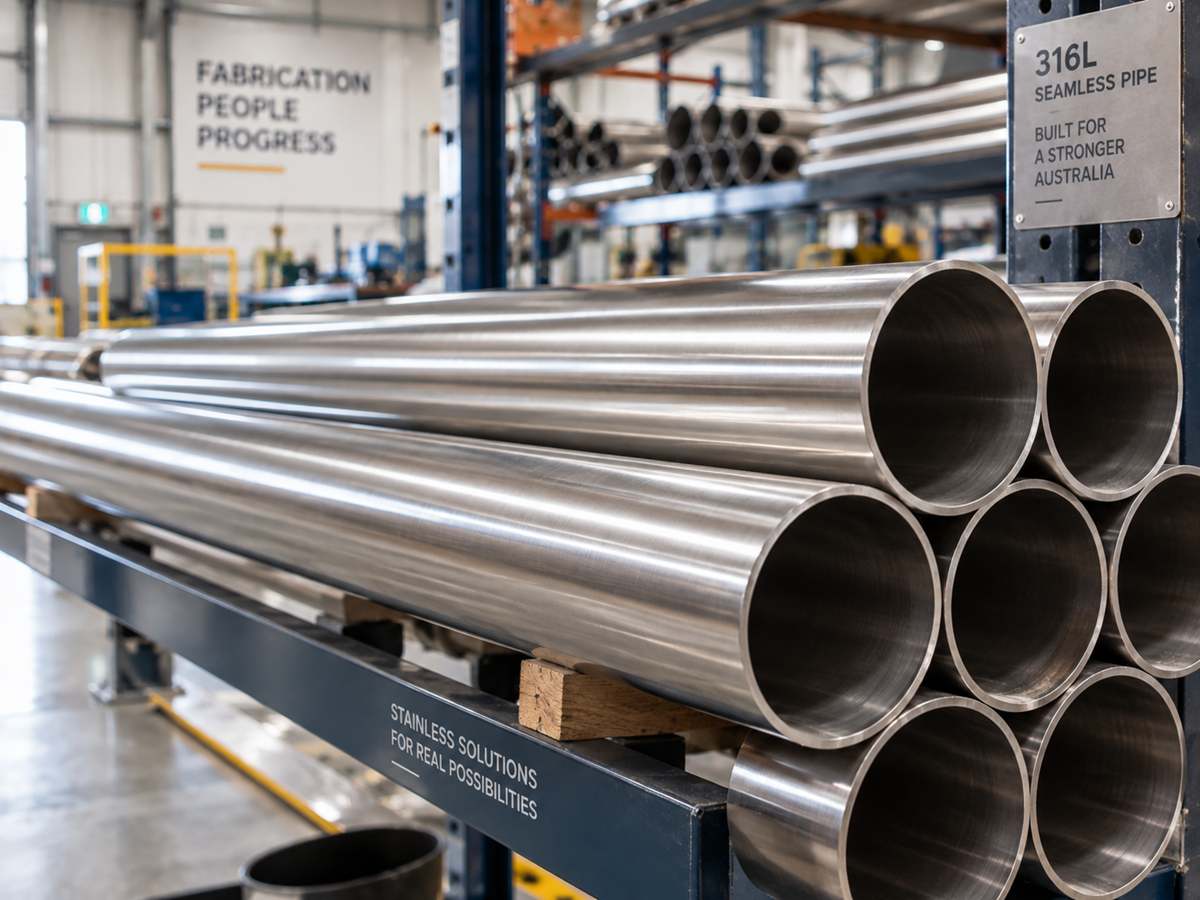
Seamless vs Welded Stainless Steel Pipe: What Actually Matters for Your Application

Ask most people outside the industry what separates seamless pipe from welded pipe, and the honest answer is usually a shrug: “it’s all just pipe.” Ask an engineer specifying pressure-critical or high-purity infrastructure, and the distinction matters enormously. Stainless steel seamless pipe is manufactured without a longitudinal weld seam, giving it structural and performance characteristics that welded pipe, however well made, simply can’t fully replicate. For engineers, plumbers, and procurement teams working across high-pressure, high-temperature, or hygiene-critical applications, understanding when seamless construction genuinely earns its higher price tag and when it doesn’t is a specification decision worth getting right.
How Seamless Pipe Is Actually Made
Seamless pipe starts life as a solid round billet of steel, which is heated and then pierced through its centre to form a hollow tube, before being rolled and drawn down to the required diameter and wall thickness. There’s no welding involved at any stage of forming the final tube shape; the entire cross-section is a single, continuous piece of metal.
Welded pipe, by contrast, starts as flat strip or plate, which is rolled into a cylindrical shape and then welded along the seam where the edges meet. Modern welding techniques, particularly automated processes with rigorous quality control, produce extremely strong and reliable welded pipe for the vast majority of applications, but a weld seam is still, by definition, a different metallurgical structure than the parent material around it, and that difference is exactly what drives the choice between the two in demanding applications.
Where the Performance Difference Actually Matters
The absence of a weld seam gives stainless steel seamless pipe genuine advantages in specific, demanding applications:
- High-pressure service — without a seam to act as a potential stress concentration point, seamless pipe generally offers superior performance under high internal pressure, particularly relevant in oil and gas, high-pressure steam, and hydraulic applications
- High-temperature applications — the uniform metallurgical structure performs more predictably under thermal cycling than a welded joint, which can behave slightly differently to the parent material under repeated heating and cooling
- Corrosive or high-purity media — in pharmaceutical, semiconductor, or ultra-high-purity applications, the absence of a weld seam removes a potential site for micro-crevices where contamination or corrosion could otherwise initiate
- Critical safety applications — where failure consequences are severe, the elimination of weld-related risk factors provides an additional margin of confidence that many specifications require as standard
For general industrial fluid transport at moderate pressures and temperatures, the majority of applications across warehouses, factories, and standard process piping, high-quality welded pipe performs entirely adequately and typically at a meaningfully lower cost. The decision to specify seamless generally comes down to whether the application sits in one of these genuinely demanding categories, rather than defaulting to seamless as a blanket “better safe than sorry” choice that adds unnecessary cost to a project.
Cost Considerations: Why Seamless Carries a Premium
Seamless pipe is more expensive to manufacture than welded pipe, and that cost difference flows directly through to the price a buyer pays. The piercing and drawing process is more labour and equipment-intensive than rolling and welding flat strip, and seamless pipe is generally produced in smaller batch runs with tighter dimensional tolerances, both of which add to unit cost.
For projects where budget is a genuine constraint and the application doesn’t demand seamless-specific performance characteristics, specifying seamless pipe across the board can represent unnecessary spend that would be better allocated elsewhere in the project. The more effective approach is often a hybrid specification: seamless pipe for genuinely critical, high-pressure, or high-purity sections of a system, with high-quality welded pipe for the balance of less demanding runs. This targeted approach delivers the performance benefits where they actually matter without inflating the entire project budget unnecessarily.
Dimensional Tolerances and Quality Verification
Seamless pipe typically offers tighter dimensional tolerances than welded pipe, particularly around wall thickness consistency, since the drawing process allows for more precise control than rolling and welding flat stock. For applications where dimensional precision matters tight-tolerance fittings, instrumentation, or applications requiring exact flow calculations this consistency can be a meaningful factor in the specification decision, independent of the pressure or temperature considerations already discussed.
Regardless of whether seamless or welded pipe is specified, verification remains essential. Mill certificates confirming chemical composition and mechanical properties should be requested and checked against the project’s specification, and for critical applications, non-destructive testing such as ultrasonic or radiographic inspection provides additional assurance that the pipe meets the required standard before it’s installed into a system where failure would carry serious consequences.
Making the Right Call for Your Project
The practical question worth asking for any given application isn’t “is seamless better than welded” in the abstract it’s whether the specific pressure, temperature, purity, and safety requirements of the application genuinely call for seamless construction, or whether high-quality welded pipe would perform equally well at a lower cost. Working through this question honestly at the specification stage, rather than defaulting to whichever option feels more conservative, is what delivers a project that’s both properly engineered and sensibly budgeted.
For projects spanning multiple pressure classes or applications common in larger industrial installations, a section-by-section specification approach, applying seamless pipe only where the performance case genuinely justifies it, typically delivers the best balance between reliability and overall project cost.
Final Thoughts
The distinction between seamless and welded stainless steel pipe isn’t a matter of one being universally superior to the other; it’s a matter of matching construction method to the genuine demands of the application. Seamless pipe earns its premium in high-pressure, high-temperature, and high-purity environments where the absence of a weld seam delivers a real performance advantage. For everything else, quality welded pipe does the job reliably at a more accessible price point. Understanding where that line actually sits rather than assuming it’s always worth paying more for seamless is what separates a well-specified project from one that’s simply over-engineered.